Oct. 19, 2026
Share
Enamel quality control for cast iron cookware must verify more than color and surface appearance. A reliable inspection program should confirm that the casting is sound, the enamel is properly bonded, the cooking surface is suitable for food contact, and finished products remain consistent across a bulk order.
For importers, wholesalers, private-label brands, and retail chains, the most effective approach is to define measurable requirements before production. Without an approved sample, defect limits, test methods, and a sampling plan, decisions about pinholes, color variation, rim coverage, or minor surface marks can become subjective after the goods are finished.
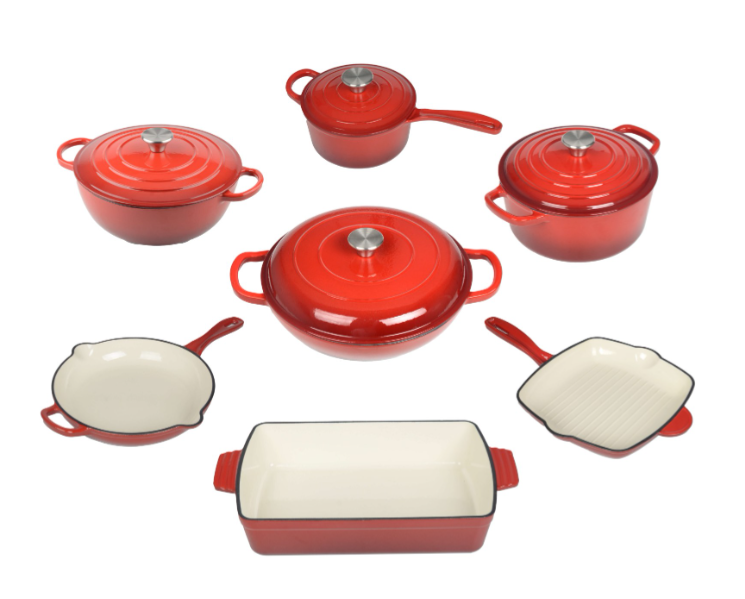
Vitreous enamel is a glass-like coating fused to cast iron at high temperature. Its performance depends on the relationship between the casting, surface preparation, enamel formula, application thickness, and firing cycle. A visually attractive coating can still fail if the iron beneath it contains cracks, contamination prevents adhesion, or the firing conditions are inconsistent.
Quality control should therefore begin before enameling and continue through packaging. Final inspection alone may identify defective cookware, but it cannot efficiently correct a process that has already produced an entire batch.
The cookware body should be checked before enamel application. Inspect for cracks, excessive porosity, sand inclusions, sharp flash, deformation, unstable bases, and dimensions outside the approved drawing. Lid fit and contact points should also be checked at this stage.
Enamel cannot repair a structurally defective casting. It may cover small surface irregularities visually, but cracks, deep pits, or unstable geometry can reappear as coating defects or product failures after firing.
The iron surface must be clean and suitably prepared so the enamel can bond to it. Oil, rust, dust, casting residue, or incomplete blasting can create weak areas that later appear as blistering, peeling, bare spots, or premature chipping.
Factories should monitor cleaning and blasting procedures, prevent contamination after preparation, and limit the time between surface preparation and enamel application. Prepared cookware should not be handled in a way that transfers oil or dirt back onto the coating surface.
Enamel slip consistency affects coverage, color, flow, and fired thickness. Process controls may include material identification, batch traceability, density, viscosity or flow, fineness, mixing time, and application parameters. The exact controls depend on the enamel system and application method.
Coating should be distributed consistently across the cooking surface, walls, handles, lid, and exterior. Edges, rims, tight corners, logo areas, and handle joints require particular attention because they are common locations for thin coverage, runs, or impact damage.
Firing bonds the enamel to the iron. The furnace temperature profile, heating time, loading pattern, and cooling conditions should be controlled for each product design and enamel formula. Underfiring may produce weak bonding or an immature surface, while excessive heat can cause color shift, distortion, sagging, or other coating problems.
Any change to the enamel material, casting source, product thickness, furnace settings, or loading method should be reviewed because it may affect the approved result.
Defects should be classified by location, size, frequency, and effect on safety or use. A small cosmetic mark on the exterior does not have the same significance as exposed iron or a chip on the food-contact surface.
| Defect or Condition | What to Check | Typical Purchasing Decision |
|---|---|---|
| Crack in the casting | Location, depth, and whether it passes through the body | Treat as a critical structural defect and reject the unit. |
| Chipped interior enamel | Exposed iron, sharp edges, and loose coating around the chip | Do not accept for normal sale as food-contact cookware. |
| Pinholes or bare spots | Number, diameter, depth, location, and exposed substrate | Judge against written limits; cooking-surface defects require stricter control. |
| Runs, sags, or excessive buildup | Sharpness, uneven thickness, appearance, and interference with lid fit | Reject when function, safety, packaging, or agreed appearance is affected. |
| Color or gloss variation | Approved master sample, lighting, viewing distance, and lot consistency | Accept only within the agreed visual or instrumental tolerance. |
| Black specks or inclusions | Whether they are surface contamination, exposed iron, or embedded particles | Classify by cause and location rather than color alone. |
| Rough or uneven rim | Approved rim design, exposed areas, sharp edges, and lid contact | Compare with the specification; rim construction must be defined before production. |
| Wobble or poor lid fit | Base flatness, lid seating, rocking, and dimensional tolerance | Reject when performance exceeds the agreed tolerance. |
Natural variation in cast and fired products does not eliminate the need for clear limits. Buyers should approve a physical reference sample and a defect catalogue containing photographs of acceptable and unacceptable conditions.
The required test program should match the product claims, intended use, and destination market. Depending on the cookware design, buyers may specify the following:
A test name alone is insufficient. The purchase specification should identify the method, acceptance limit, test frequency, responsible laboratory, and action required after a failure.
Begin with a signed product specification covering drawings, materials, enamel finish, color reference, dimensions, components, markings, packaging, and destination-market requirements. For coordinated cast iron cookware sets, define whether every piece must match exactly or whether an agreed color range is acceptable across different shapes and firing loads.
Approve a pre-production sample before mass manufacturing. Keep matching reference samples with the buyer and supplier, and record any approved deviations. If a custom color is involved, evaluate it under defined lighting rather than relying only on phone photographs or different computer screens.
During production, retain process and inspection records by batch. Final inspection should include both 100% screening for readily visible critical defects and a documented sampling plan for other appearance, dimensional, functional, and packaging checks. An AQL inspection does not guarantee that every unit is defect-free; it provides a defined method for accepting or rejecting a lot based on sampled results.
Critical, major, and minor defects should have separate limits. Critical safety defects are normally assigned zero acceptance, while major and minor limits should be agreed according to the product, price level, sales channel, and buyer risk. Do not adopt a generic AQL value without first defining which defects belong in each class.
A useful quality file may include the approved specification and sample, incoming casting records, enamel batch identification, firing records, in-process inspection results, finished-product reports, food-contact test reports, corrective-action records, and shipment inspection results.
Reports should identify the tested product, color or enamel system, production batch, test method, result, and date. A report for another model or an earlier enamel formula may not represent the goods being purchased.
KUFU supplies enameled cast iron cookware for importers, wholesalers, retailers, and private-label brands, with options for custom colors, logos, product designs, and packaging. Buyers can contact our team to discuss product specifications, samples, inspection requirements, cookware set configurations, and quotations for bulk purchasing programs.